
Designing Otherwise: Notes from More Than Human
A reflection on the exhibition at the Design Museum and its call to rethink design as political, relational, and more-than-human.


AI SUMMARY:
Reflections on More Than Human, an exhibition that rethinks design not as a tool for solving problems, but as a way of noticing, relating, and redistributing life across species. The exhibition favours speculative and artistic approaches — from river-rights murals to gardens for pollinators — suggesting that design might be less about building the future and more about inhabiting the present differently. Drawing on ideas from Andrés Jaque and Anna Tsing, Carolina Lio explores how design can shift from mastery to care, from extraction to entanglement. At its core, the piece argues that attention, imagination, and relational thinking are not distractions from urgent realities, but essential tools for shaping more livable worlds.
Why do we add an AI summary to our posts? We value your time and want to provide you with more information before you read the entire text.
Article written by Carolina Lio for Looking Forward
With over 140 works by more than 50 artists, architects, and designers, More Than Human, the Future Observatory’s major exhibition at the Design Museum, closing this week, is a truly polyphonic exhibition about repair, inter-species reciprocity, and learning to live otherwise.
At the heart of it lies a deceptively simple question: what would design look like if it prioritised (also) the needs of other species, and didn’t just cater for humans? The answers emerge as a constellation of speculative, site-specific, and sometimes utopian propositions, ranging from fungal claddings to murals about river rights.
As perfectly summarised by Justin McGuirk, Director of Future Observatory and co-curator of the exhibition with Rebecca Lewin:
This isn’t just another show about ‘sustainable design’. It’s a radical rethink of design’s role in the world. Many of the works are still experimental, but they show a clear shift in thinking. Design isn’t just about human needs anymore, but about helping the living systems we all depend on. More Than Human is what design needs to become in the 21st century.
And, in fact, leaving the exhibition, one hasn’t learned about any new plan to reduce (again) the carbon footprint, but with something far more radical: a new way to see the world by design. Through projects that function as a form of spatial storytelling, turning cartography, ritual, policy, and speculative planting into modes of advocacy, one gradually steps into a new modality of interpreting the world.
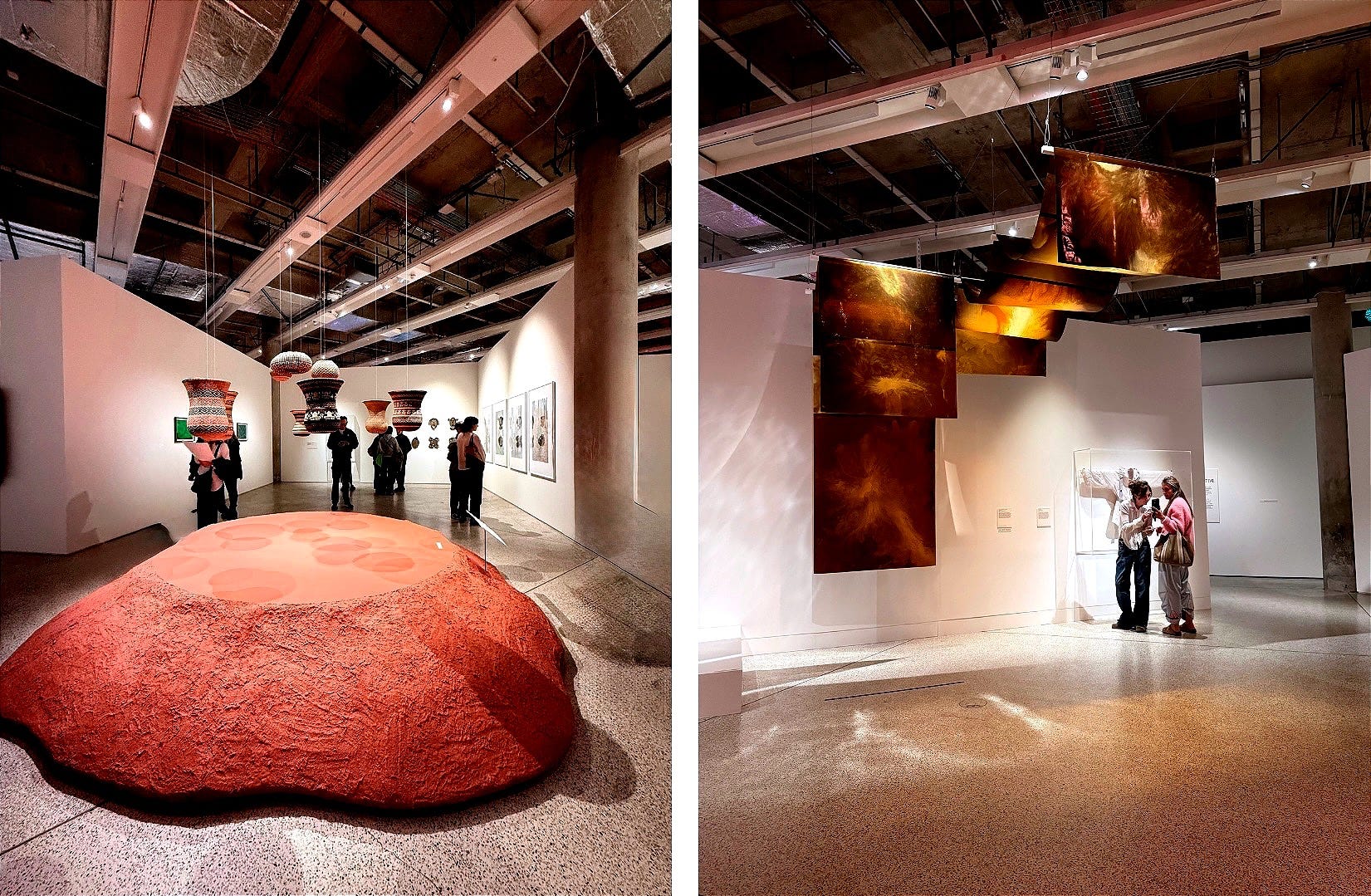
Of course, exhibitions and design approaches focused on sustainability and reducing environmental impact are necessary and welcome. But More Than Human offers something else alongside that. What lingers is not a catalogue of solutions, but a shift in perspective. Many of the works feel closer to artistic practices than to conventional design, drawing on animist traditions, speculative gestures, and rituals of care. There is a sense that design here is not just trying to solve problems within an existing worldview, but instead trying to redefine our entire relationship with the world. Rather than treating nature as a backdrop or a resource, these projects ask what it means to relate to rivers, forests, insects, and coastlines as legal subjects, as collaborators, as kin. In that sense, the exhibition gestures towards a longer-term transformation of how we inhabit the world.
The four commissioned research projects developed through the More Than Human Fellowship 2024–25 offer a clear example of this approach and a glimpse of what this future-facing design might look like in practice.
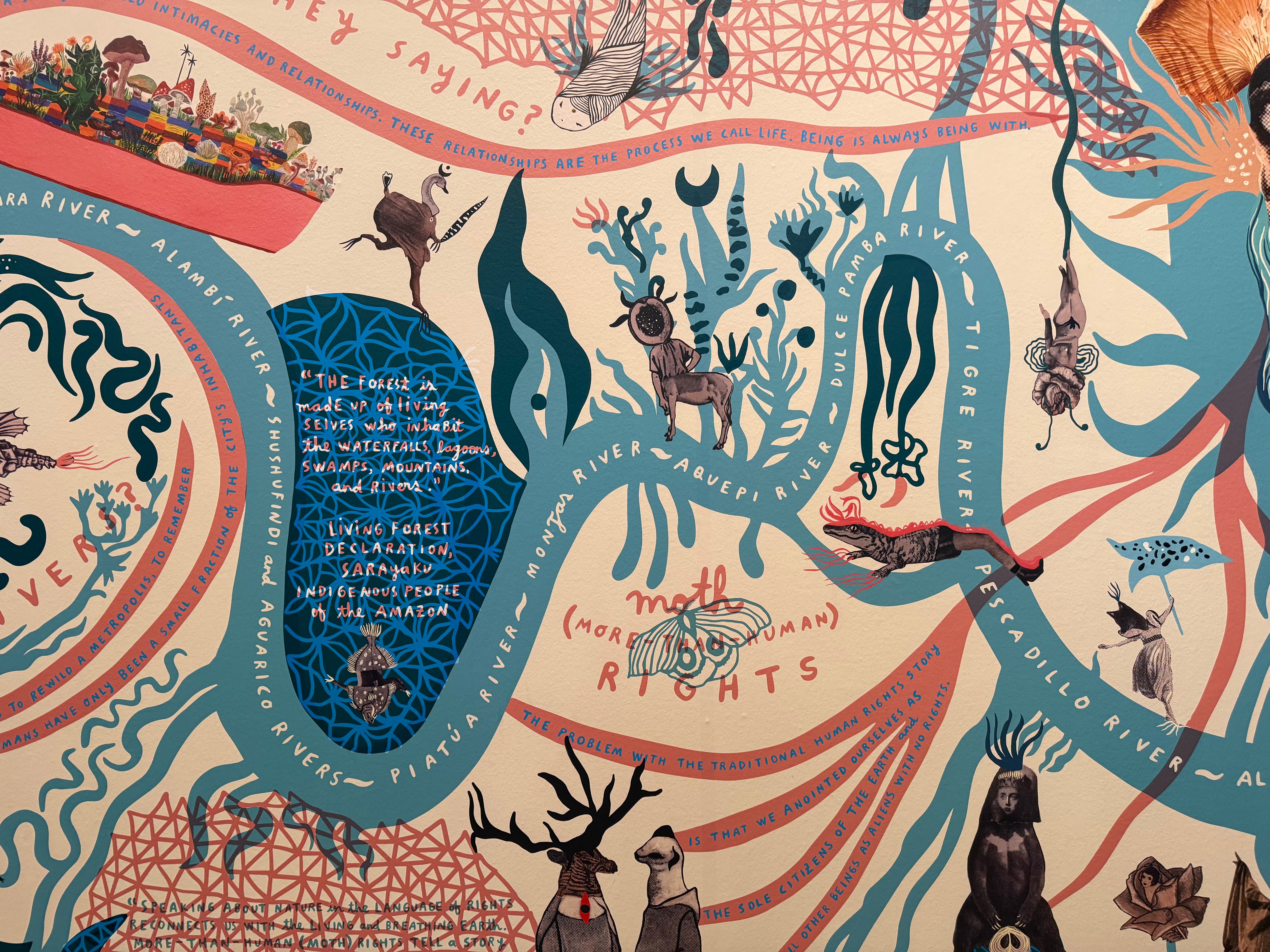
The More-Than-Human Rights Mural, by artist Elena Landinez and legal scholar César Rodríguez-Garavito, explores the global movement for the legal personhood of rivers, which is already recognised in countries like Colombia, New Zealand, and Ecuador. Their eight-metre mural combines legal documents, imagery, and cartographic elements to portray rivers as living legal subjects. Some sections are only visible through coloured acetate lenses, revealing the hidden frameworks that shape environmental relations. The work challenges viewers to consider who speaks for nature, how legal rights are assigned, and what justice might look like when ecosystems are treated as entities with legal standing.
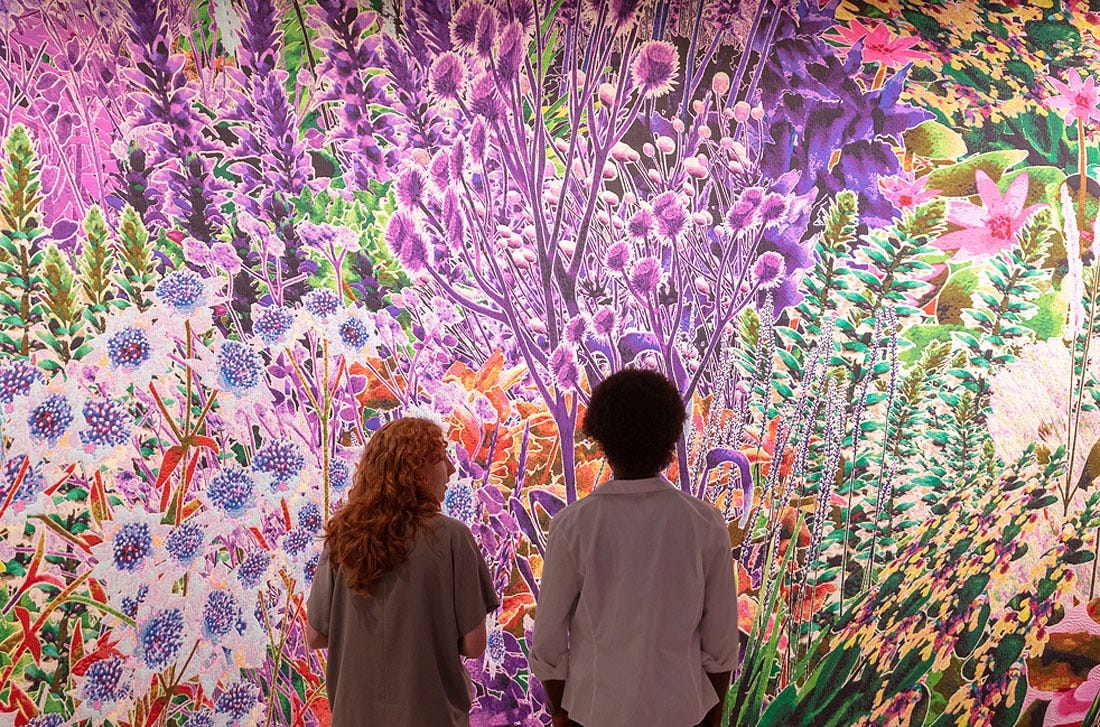
Alexandra Daisy Ginsberg’s Pollinator Pathmaker rethinks garden design from the perspective of insects. Using a custom algorithm, the project generates planting schemes that prioritise biodiversity and pollinator wellbeing rather than human preferences. The tapestry on display translates one of these living gardens into a visual artwork, offering a glimpse into a design process that centres nonhuman needs. The work proposes a future where gardens are not decorative, but restorative, and where design becomes an act of ecological empathy.
Paulo Tavares, with the Guarani Mbya people, architecture students, and the Chão Collective, created a spatial campaign supporting Indigenous land claims in São Paulo, Earthly Memorials: São Paulo Terra Indígena. Focusing on the last fragment of Atlantic Forest in the Jaraguá region, the project combines oral histories, mapping, and a 3D model to present the forest as sacred land. Positioned as both a memorial and a legal tool, it affirms that landscapes carry memory, agency, and a right to recognition.
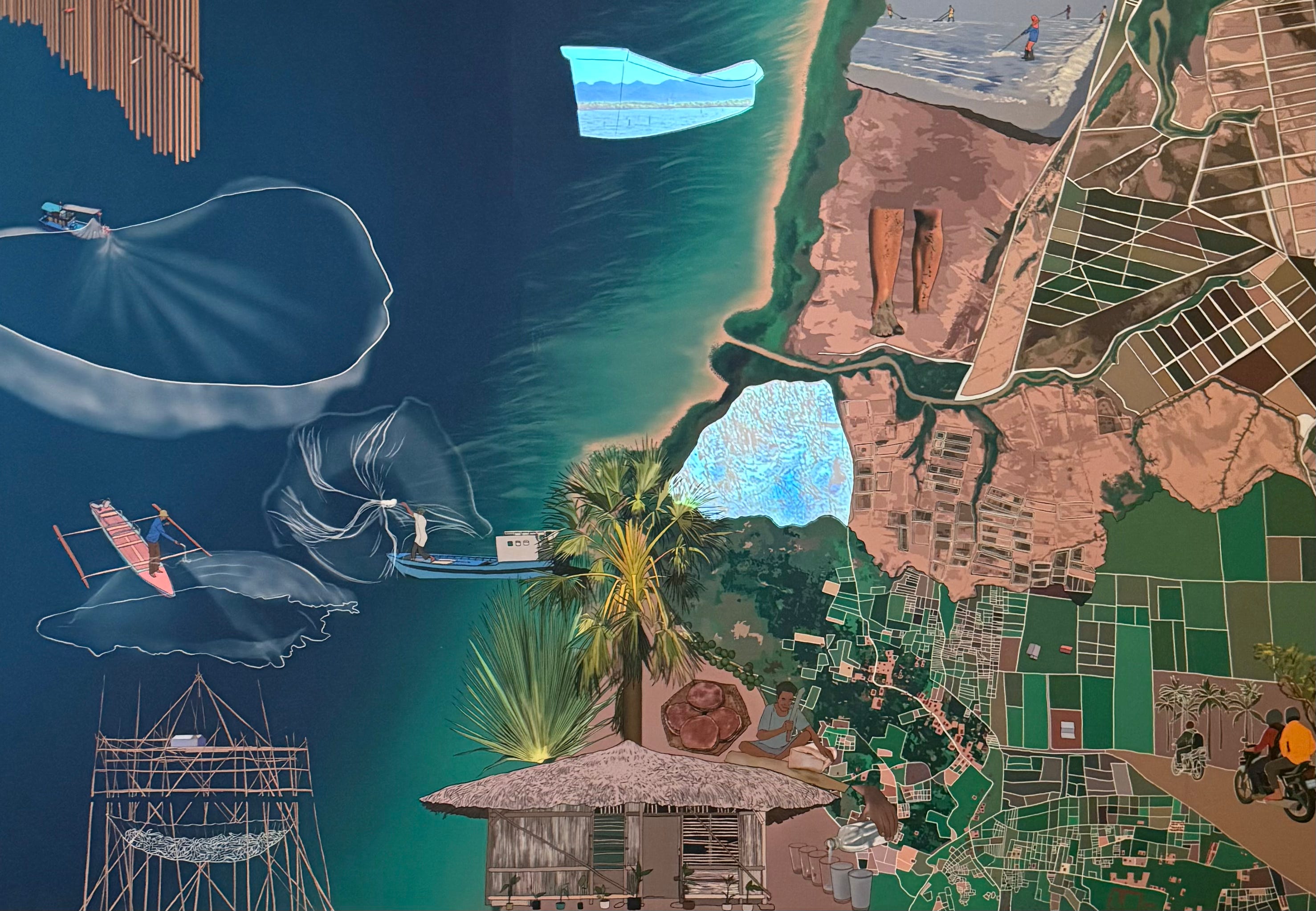
In The Coast Is Not a Line, It’s a Zone, Feifei Zhou reimagines coastlines as fluid ecological and political zones rather than fixed borders. Based on fieldwork in Kupang Bay, West Timor, her project documents how local communities navigate the impacts of rising sea levels and industrial pressures. Through annotated maps, drawings, and film, Zhou shows the coast as a space of entanglement between land, sea, humans, and more-than-human life. Her work challenges dominant planning models and calls for design rooted in local knowledge and lived experience.
Beyond these commissions, the exhibition ranges widely in material and context.
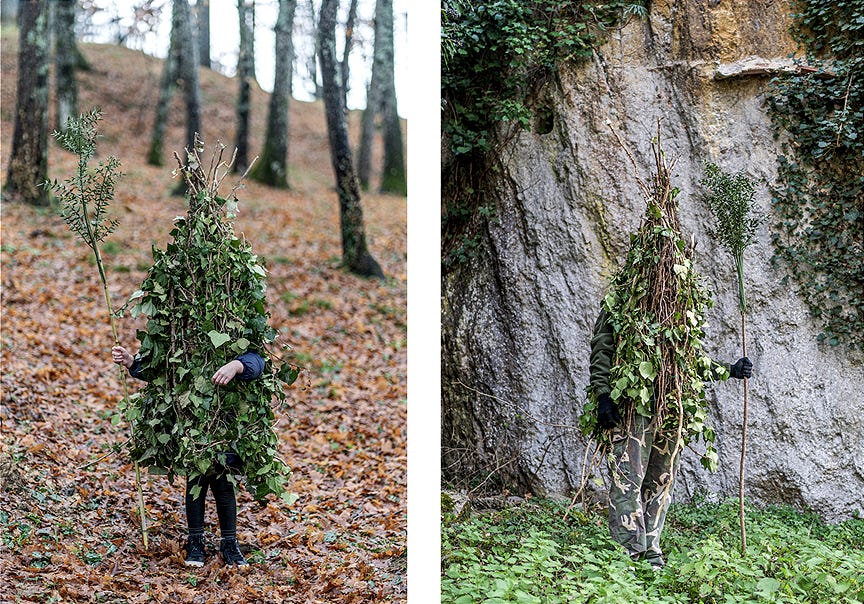
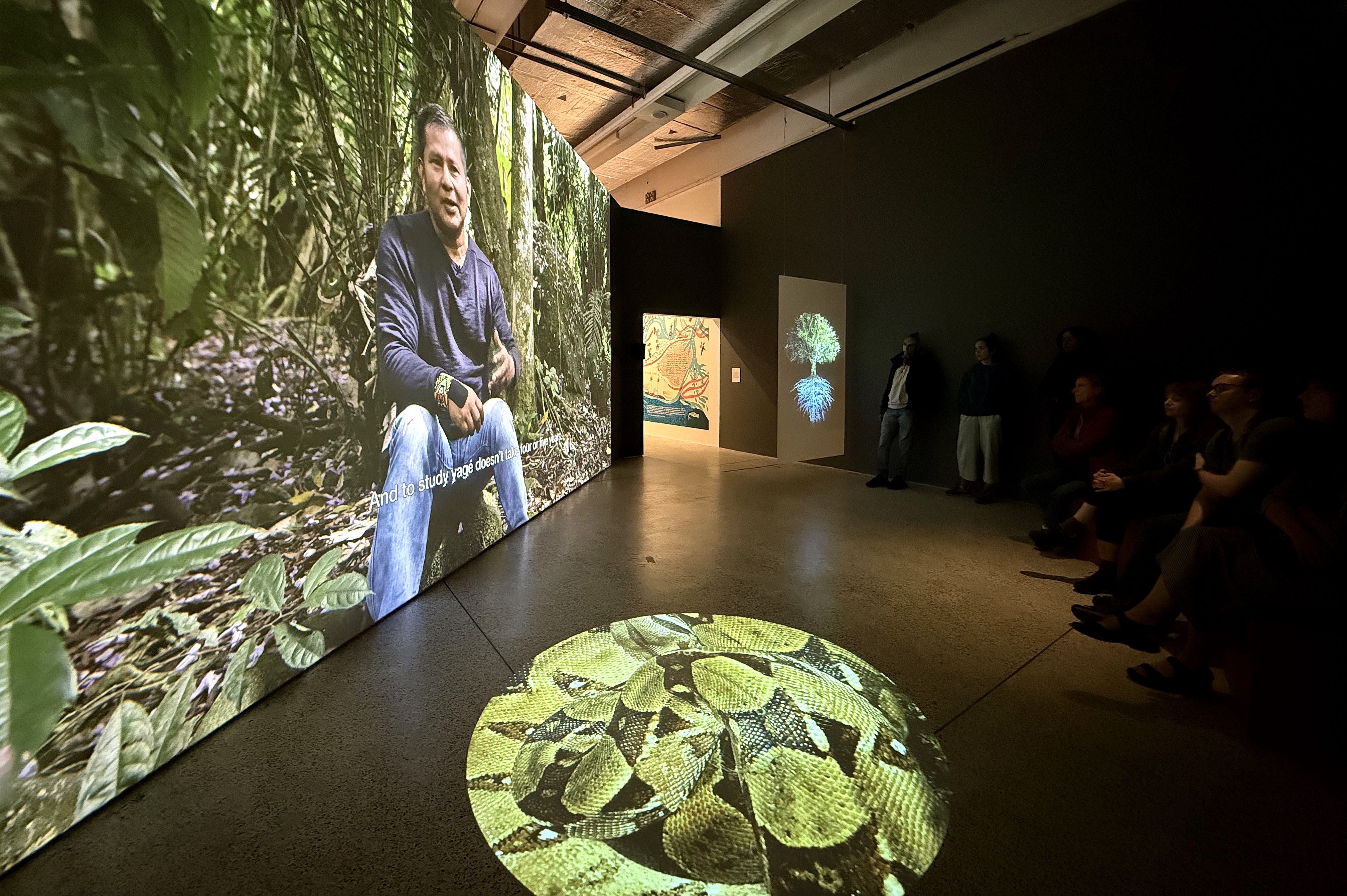
Among its most compelling pieces are baskets by the Association of Women Weavers of Caura Adooni, representing the Ye’kuana people of the Venezuelan Amazon. For the Ye’kuana, weaving is a ritual practice embedded in the forest ecosystem. Materials are gathered following traditional protocols that involve singing and spiritual permission. Amongst other works that introduce ritual and spiritual knowledge is the photos of Federico Borella and Michela Balboni on the Rumiti processions in Basilicata, Italy, showing men dressed as trees walking through the forest in a ceremonial act of kinship. These objects reflect a worldview in which everything in nature is animate and interconnected and that Ursula Biemann further explore in Forest Mind (2021), a video installation created in collaboration with ETH Zurich in which data from Western scientific research and Amazonian shamanic knowledge are combined.
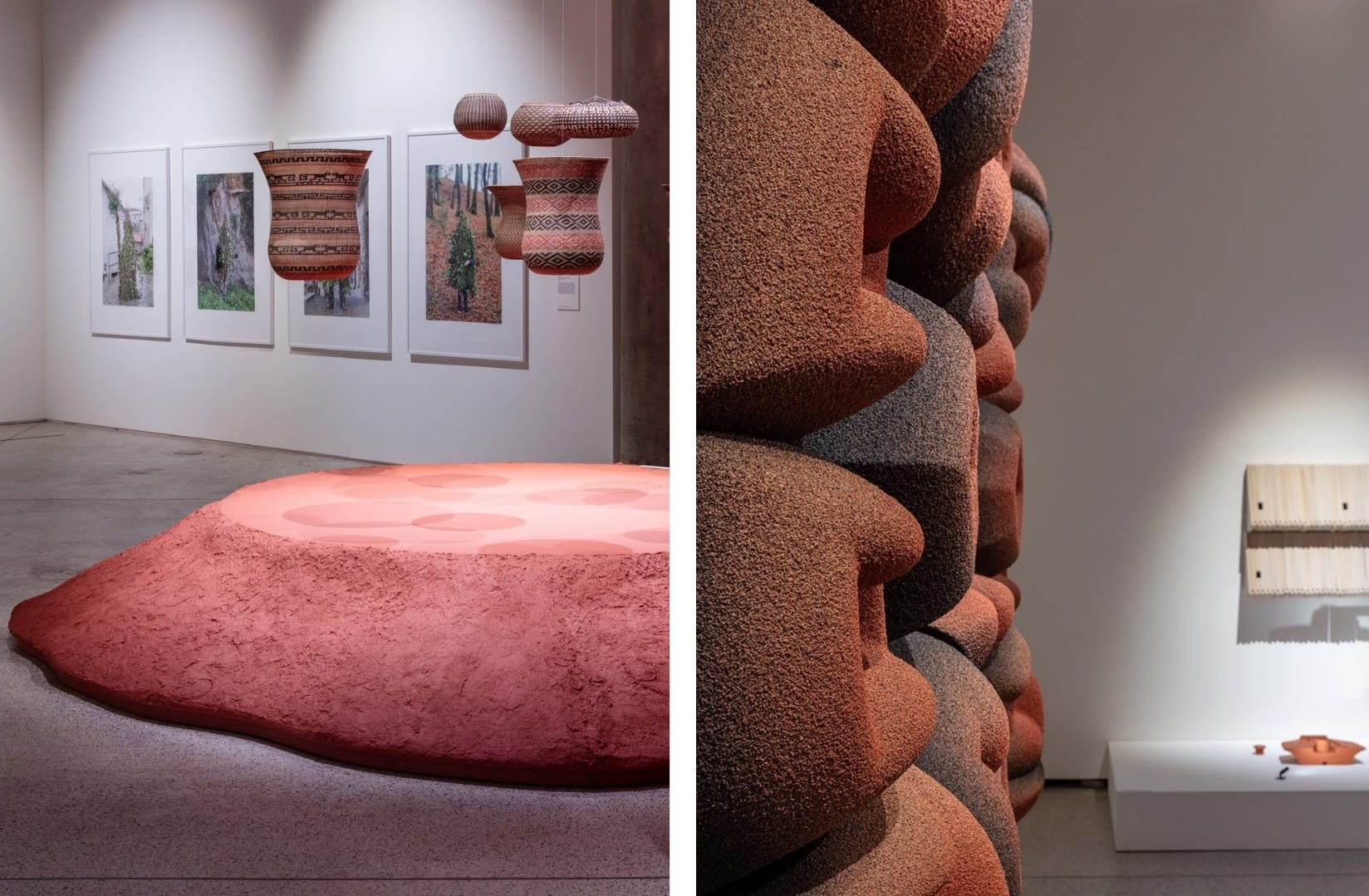
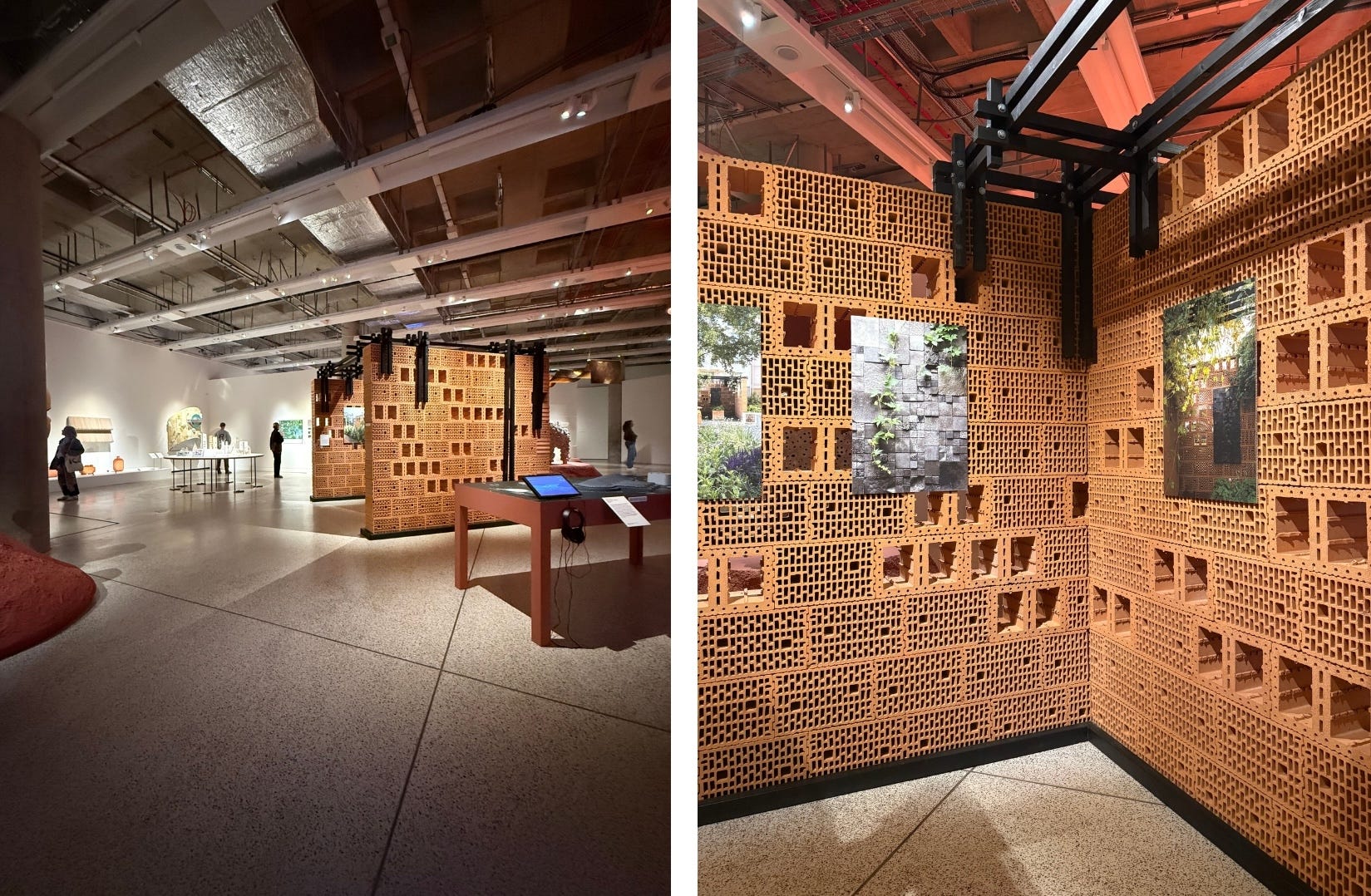
Architect Andrés Jaque contributes the Transspecies Rosette, a building façade reimagined as a space of cohabitation and made from porous cork. This living surface is designed to host moss, fungi, insects and bacteria. Instead of acting as a barrier between humans and the environment, the building becomes a habitat shared with other species. On a similar line of thought, the Alusta Pavilion by Suomi/Koivisto Architects is a structure that uses standard bricks rotated to create gaps that provide shelter for insects. Originally built with clay coatings and planted surroundings, the pavilion is a hybrid of human architecture and wildlife habitat.
Among the many perspectives that surface across the exhibition, the catalogue, and the Future Observatory Journal issue (link) dedicated to More Than Human, I would like to highlight those from Andrés Jaque and Anna Tsing.
Andrés Jaque argued for a fundamental redefinition of design’s purpose. In conversation with Lucia Pietroiusti and Paulo Tavares, he challenged the idea that design is primarily about proposing solutions or creating isolated objects. Instead, he described design as a material and political practice, one that actively constructs the infrastructures through which life is distributed. Jaque asked whether we can imagine a world no longer organised around “zones of sacrificability”: those places and populations historically subjected to extraction, pollution, and displacement. For him, the future of design lies in redistributing not only resources but also the capacity to live, across both human and more-than-human communities. He linked environmental degradation to systems of racialisation and colonial violence, emphasising that design cannot be neutral. It either reproduces these systems or intervenes in them.
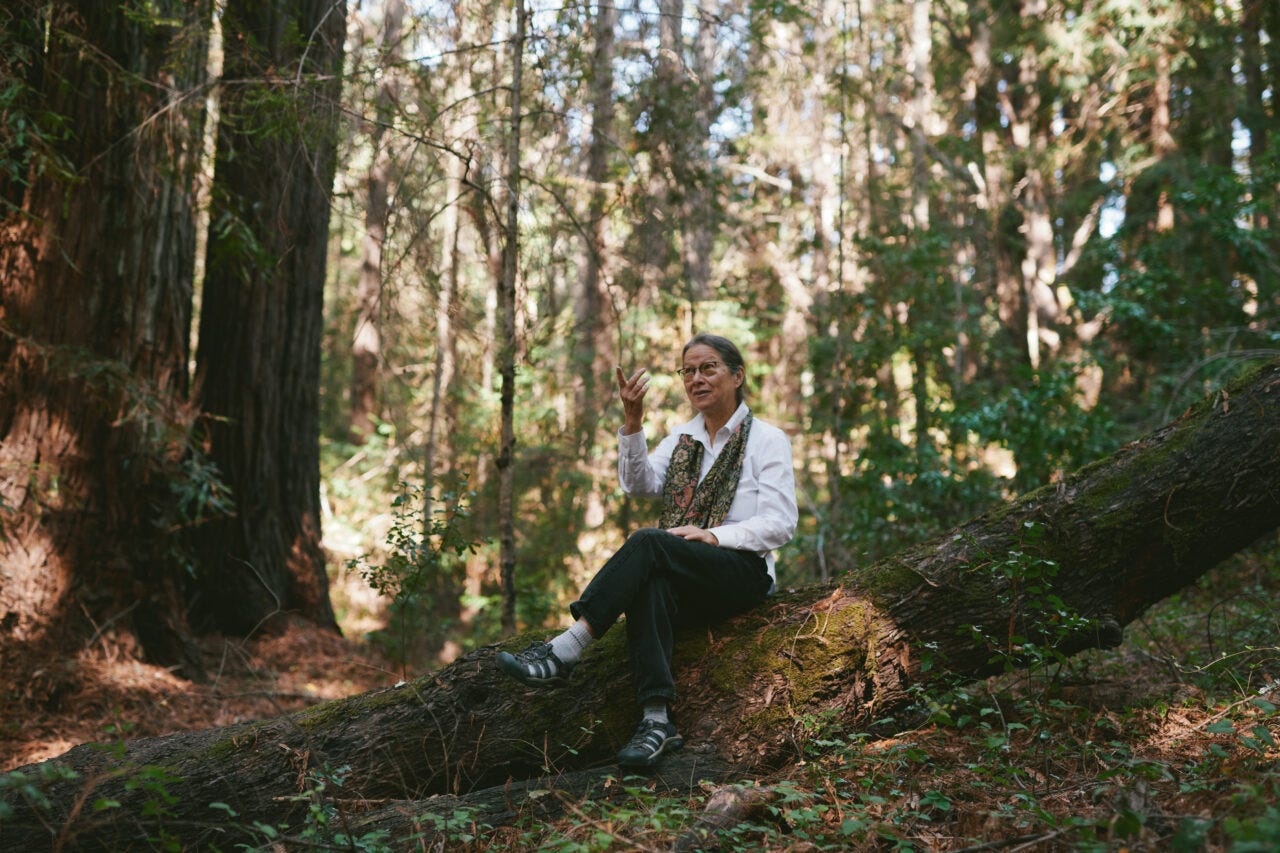
Anna Tsing, in her conversation with Justin McGuirk, takes this thinking into a different register. While Jaque foregrounds the structural and spatial, Tsing turns to the sensory and perceptual. She speaks of “noticing” as a political act, a refusal to be swept along by the momentum of modernist progress, which narrows vision to a single imagined future. For her, design begins with attention: to what is already here, already alive, already entangled. She calls for an attunement to what she terms “feral effects”: the unpredictable outcomes that arise when human intentions meet the unruly agency of other beings and systems. Alongside this, she proposes “autumn thinking”: a way of valuing limits, endings, and decay, rather than defaulting to growth and accumulation.
“Noticing is my way of opposing a particular modernist practice of looking towards an imagined future… we develop blinders so that all we can see is our trajectory towards one kind of imagined future. And so, we stopped seeing.”
Jaque and Tsing offer two entry points into a shared proposition: that design must be reoriented away from mastery and towards relation. One begins with infrastructure, the other with perception, but both insist that design is a world-making force, not just a matter of form or function, but of how we see, organise, and share life.
That this process of transformation is going to be seen as long-term and relates to a change of worldview rather than yet another toolkit is indicated by the significant number of the exhibited projects leaning towards speculative research, often with limited immediate application. Some examples embrace this distance entirely, such as the wearable structure by Thomas Thwaites designed to experience life as if he was a goat, the founding of a Dolphin Embassy by the architecture collective Ant Farm, or Shimabuku’s series of objects conceived to be collected by octopuses. For audiences grounded in practical design disciplines, this might feel abstract or disconnected from material outcomes. Yet, for those approaching from realms in which quick problem solving is not expected (such as contemporary art or critical theory), this speculative mode becomes a notable strength rather than a flaw. It opens space for imagination, for rehearsing future scenarios, and for asking different questions about design’s purpose and responsibilities.
More Than Human suggests that the role of design today is not only to intervene in systems, but to rethink what systems are, who they serve, and how they are imagined in the first place. In this sense, speculation is not an escape from reality, but a method for staying with its complexities. It is an insistence that other worlds are possible, and that design, if it is to matter, must help us notice them, name them, and begin to build them.
More than Human is on view at the Design Museum until 05 October 2025
Further Readings:
Jaque, Andrés, Marina Otero Verzier, and Lucia Pietroiusti (eds.). More-than-Human. Het Nieuwe Instituut, 2021. | McGuirk, Justin (ed.). More Than Human: Making with the Living World. Design Museum, 2025. (buy here) | Solomon, Anna. Design beyond humans: a new exhibition argues that the world doesn’t revolve around us. Wallpaper Magazine, 2025. (read here) | Tsing, Anna. Noticing Is My Way of Opposing. Interview by Justin McGuirk. Future Observatory Journal, 2025. (read here) | Wainwright, Oliver. More than Human review – a utopia of self-weaving grass and psychedelic dolphins. The Guardian, 2025. (read here)